![D-Link DGS-3024 — настройки VLAN и управление портами в сетевых коммутаторах [48/184]](/icons/site-icon-64.png)
D-Link DGS-3024 — настройки VLAN и управление портами в сетевых коммутаторах [48/184]
Превью страниц
Страница 48 /
184
![D-Link DGS-3024 [48/184] Tagging and untagging](/views2/1043627/page48/bg30.png)
D-Link DES-3350SR Standalone Layer 3 Switch
38
Advertisement
Advertising can be enabled or disabled
using this pull-down menu. Advertising
allows members to join this VLAN
through GVRP.
Port Settings
Allows an individual port to be specified
as member of a VLAN.
Tagged/None
Allows an individual port to be specified
as Tagging. A check in the Tagged field
specifies the port as a Tagging member
of the VLAN. When an untagged packet
is transmitted by the port, the packet
header is changed to include the 32-bit
tag associated with the VID (VLAN
Identifier – see below). When a tagged
packet exits the port, the packet header
is unchanged.
None
Allows an individual port to be specified
as None. When an untagged packet is
transmitted by the port, the packet
header remains unchanged. When a
tagged packet exits the port, the tag is
stripped and the packet is changed to an
untagged packet.
Egress
Egress Member - specifies the port as
being a static member of the VLAN.
Egress Member Ports are ports that will
be transmitting traffic for the VLAN.
These ports can be either tagged or
untagged.
Forbidden
Forbidden Non-Member - specifies the
port as not being a member of the VLAN
and that the port is forbidden from
becoming a member of the VLAN
dynamically.
Port VLAN ID(PVID)
Packets that are tagged (are carrying the 802.1Q VID information) can be transmitted from one 802.1Q compliant network device
to another with the VLAN information intact. This allows 802.1Q VLANs to span network devices (and indeed, the entire
network – if all network devices are 802.1Q compliant).
Unfortunately, not all network devices are 802.1Q compliant. These devices are referred to as tag-unaware. 802.1Q devices are
referred to as tag-aware.
Prior to the adoption 802.1Q VLANs, port-based and MAC-based VLANs were in common use. These VLANs relied upon a Port
VLAN ID (PVID) to forward packets. A packet received on a given port would be assigned that port’s PVID and then be
forwarded to the port that corresponded to the packet’s destination address (found in the switch’s forwarding table). If the PVID of
the port that received the packet is different from the PVID of the port that is to transmit the packet, the switch will drop the packet.
Within the switch, different PVIDs mean different VLANs. (remember that two VLANs cannot communicate without an external
router). So, VLAN identification based upon the PVIDs cannot create VLANs that extend outside a given switch (or switch stack).
Every physical port on a switch has a PVID. 802.1Q ports are also assigned a PVID, for use within the switch. If no VLANs are
defined on the switch, all ports are then assigned to a default VLAN with a PVID equal to 1. Untagged packets are assigned the
PVID of the port on which they were received. Forwarding decisions are based upon this PVID, insofar as VLANs are concerned.
Tagged packets are forwarded according to the VID contained within the tag. Tagged packets are also assigned a PVID, but the
PVID is not used to make packet forwarding decisions, the VID is.
Tag-aware switches must keep a table to relate PVIDs within the switch to VIDs on the network. The switch will compare the VID
of a packet to be transmitted to the VID of the port that is to transmit the packet. If the two VIDs are different, the switch will drop
the packet. Because of the existence of the PVID for untagged packets and the VID for tagged packets, tag-aware and tag-unaware
network devices can coexist on the same network.
A switch port can have only one PVID, but can have as many VIDs as the switch has memory in its VLAN table to store them.
Because some devices on a network may be tag-unaware, a decision must be made at each port on a tag-aware device before
packets are transmitted – should the packet to be transmitted have a tag or not? If the transmitting port is connected to a tag-
unaware device, the packet should be untagged. If the transmitting port is connected to a tag-aware device, the packet should be
tagged.
Tagging and Untagging
Every port on an 802.1Q compliant switch can be configured as tagging or untagging.
Содержание
521- User s guide
- D link des 3350sr standalone layer 3 switch
- Table of contents
- Intended readers
- D link des 3350sr standalone layer 3 switch
- Preface
- Notes notices and cautions
- D link des 3350sr standalone layer 3 switch
- Safety instructions
- Safety cautions
- Protecting against electrostatic discharge
- General precautions for rack mountable products
- D link des 3350sr standalone layer 3 switch
- D link des 3350sr standalone layer 3 switch
- Section 1
- Performance features
- Introduction
- Gigabit ethernet technology
- Fast ethernet technology gigabit ethernet technology switch stacking performance features ports
- Fast ethernet technology
- D link des 3350sr standalone layer 3 switch
- Switching technology
- Spanning tree
- Software features
- Management
- Ip multicast
- D link des 3350sr standalone layer 3 switch
- Configuration
- Security
- Routing protocol
- Port trunking
- Port configuration and monitoring
- Mib support
- D link des 3350sr standalone layer 3 switch
- Access control list support acl
- D link des 3350sr standalone layer 3 switch
- D link des 3350sr standalone layer 3 switch
- Unpacking installation power on
- Unpacking and setup
- Unpacking
- Section 2
- Rack installation
- Installation
- Desktop or shelf installation
- Power on
- Power failure
- D link des 3350sr standalone layer 3 switch
- Section 3
- Rear panel
- Identifying external components
- Front panel rear panel side panels gigabit combo ports led indicators
- Front panel
- D link des 3350sr standalone layer 3 switch
- Side panels
- Led indicators
- Gigabit combo ports
- D link des 3350sr standalone layer 3 switch
- Switch to hub or switch
- Switch to end node switch to hub or switch 10base t device 100base tx device
- Switch to end node
- Section 4
- D link des 3350sr standalone layer 3 switch
- Connecting the switch
- Base tx device
- Base t device
- Introduction to switch management
- D link des 3350sr standalone layer 3 switch
- Connecting the console port rs 232 dce
- Command line console interface through the serial port
- Web based management interface
- Snmp based management
- Section 5
- Management options web based management interface snmp based management managing user accounts command line console interface through the serial port connecting the console port rs 232 dce first time connecting to the switch password protection snmp settings ip address assignment connecting devices to the switch
- Management options
- First time connecting to the switch
- D link des 3350sr standalone layer 3 switch
- Password protection
- D link des 3350sr standalone layer 3 switch
- Snmp settings
- D link des 3350sr standalone layer 3 switch
- Ip address assignment
- D link des 3350sr standalone layer 3 switch
- D link des 3350sr standalone layer 3 switch
- Connecting devices to the switch
- D link des 3350sr standalone layer 3 switch
- Web based switch management
- User accounts management
- Section 6
- Login to web manager
- Introduction login to web manager user accounts management admin and user privileges save changes areas of the user interface web pages
- Introduction
- User account management
- Save changes
- D link des 3350sr standalone layer 3 switch
- Admin and user privileges
- D link des 3350sr standalone layer 3 switch
- Areas of the user interface
- Area 3
- Area 2
- Area 1
- D link des 3350sr standalone layer 3 switch
- Web pages
- Section 7
- Ip address switch information advanced settings port description port configuration port mirroring igmp spanning tree forwarding filtering vlans port bandwidth sntp settings port security qos lacp access profile table ip mac binding pae access entity
- Ip address
- D link des 3350sr standalone layer 3 switch
- Configuration
- D link des 3350sr standalone layer 3 switch
- Switch information
- D link des 3350sr standalone layer 3 switch
- Advanced settings
- Port description
- D link des 3350sr standalone layer 3 switch
- Port configuration
- D link des 3350sr standalone layer 3 switch
- D link des 3350sr standalone layer 3 switch
- D link des 3350sr standalone layer 3 switch
- Port mirroring
- Igmp snooping
- D link des 3350sr standalone layer 3 switch
- Static router ports entry
- D link des 3350sr standalone layer 3 switch
- W rapid spanning tree
- Spanning tree
- Port transition states
- D link des 3350sr standalone layer 3 switch
- Stp switch settings
- P2p port
- Edge port
- D link des 3350sr standalone layer 3 switch
- D 802 w compatibility
- Stp port settings
- D link des 3350sr standalone layer 3 switch
- D link des 3350sr standalone layer 3 switch
- Unicast forwarding
- D link des 3350sr standalone layer 3 switch
- Multicast forwarding
- D link des 3350sr standalone layer 3 switch
- Vlans on the des 3350sr
- Q vlan tags
- Q vlan packet forwarding
- Ieee 802 q vlans
- D link des 3350sr standalone layer 3 switch
- Static vlan entry
- D link des 3350sr standalone layer 3 switch
- D link des 3350sr standalone layer 3 switch
- Tagging and untagging
- Port vlan id pvid
- D link des 3350sr standalone layer 3 switch
- The default vlan
- Ingress checking
- D link des 3350sr standalone layer 3 switch
- D link des 3350sr standalone layer 3 switch
- Port bandwidth
- D link des 3350sr standalone layer 3 switch
- Sntp settings
- D link des 3350sr standalone layer 3 switch
- Time zone and dst
- D link des 3350sr standalone layer 3 switch
- Current time settings
- Port security
- D link des 3350sr standalone layer 3 switch
- D link des 3350sr standalone layer 3 switch
- Qos quality of service
- D link des 3350sr standalone layer 3 switch
- Traffic control
- P default priority
- D link des 3350sr standalone layer 3 switch
- P user priority
- D link des 3350sr standalone layer 3 switch
- Traffic segmentation
- Scheduling
- D link des 3350sr standalone layer 3 switch
- Link aggregation
- D link des 3350sr standalone layer 3 switch
- D link des 3350sr standalone layer 3 switch
- D link des 3350sr standalone layer 3 switch
- Lacp port
- D link des 3350sr standalone layer 3 switch
- D link des 3350sr standalone layer 3 switch
- Access profile table
- Part 1
- Ethernet
- D link des 3350sr standalone layer 3 switch
- D link des 3350sr standalone layer 3 switch
- Packet content mask
- D link des 3350sr standalone layer 3 switch
- D link des 3350sr standalone layer 3 switch
- Part 2
- D link des 3350sr standalone layer 3 switch
- D link des 3350sr standalone layer 3 switch
- Ethernet
- D link des 3350sr standalone layer 3 switch
- D link des 3350sr standalone layer 3 switch
- Packet content mask
- D link des 3350sr standalone layer 3 switch
- D link des 3350sr standalone layer 3 switch
- D link des 3350sr standalone layer 3 switch
- Ip mac binding port
- Ip mac binding
- D link des 3350sr standalone layer 3 switch
- Ip mac binding table
- D link des 3350sr standalone layer 3 switch
- X port based and mac based access control
- Port access entity 802 x
- Ip mac binding blocked
- D link des 3350sr standalone layer 3 switch
- D link des 3350sr standalone layer 3 switch
- Client
- Authenticator
- Authentication server
- D link des 3350sr standalone layer 3 switch
- Authentication process
- Understanding 802 x port based and mac based network access control
- Radius server
- Port based network access control
- Once the connected device has successfully been authenticated the port then becomes authorized and all subsequent traffic on the port is not subject to access control restriction until an event occurs that causes the port to become unauthorized hence if the port is actually connected to a shared media lan segment with more than one attached device successfully authenticating one of the attached devices effectively provides access to the lan for all devices on the shared segment clearly the security offered in this situation is open to attack
- Network access uncontrolled port
- Network access controlled port
- Figure 7 59 example of typical port based configuration
- Ethernet switch
- D link des 3350sr standalone layer 3 switch
- Radius server
- Network access uncontrolled port
- Network access controlled port
- Mac based network access control
- Ethernet switch
- D link des 3350sr standalone layer 3 switch
- Configure authenticator
- D link des 3350sr standalone layer 3 switch
- Port capability settings
- D link des 3350sr standalone layer 3 switch
- Initialize ports for port based 802 x
- D link des 3350sr standalone layer 3 switch
- Initializing ports for mac based 802 x
- D link des 3350sr standalone layer 3 switch
- Reauthenticate ports for port based 802 x
- Reauthenticate ports for mac based 802 x
- D link des 3350sr standalone layer 3 switch
- Radius server
- D link des 3350sr standalone layer 3 switch
- Security ip
- Section 8
- Management
- D link des 3350sr standalone layer 3 switch
- User accounts
- Security ip user accounts snmp v3
- Snmpv3
- Snmp user table
- D link des 3350sr standalone layer 3 switch
- Snmp view table
- D link des 3350sr standalone layer 3 switch
- Snmp group table
- D link des 3350sr standalone layer 3 switch
- D link des 3350sr standalone layer 3 switch
- Snmp community table
- D link des 3350sr standalone layer 3 switch
- Snmp host table
- D link des 3350sr standalone layer 3 switch
- Snmp engine id
- D link des 3350sr standalone layer 3 switch
- Section 9
- Layer 3 ip networking
- Ip interface settings layer 3 global settings md5 key table settings route redistribution settings static default route settings static arp settings rip ospf dhcp bootp relay dns relay ip multicast routing protocol
- Ip interface settings
- D link des 3350sr standalone layer 3 switch
- D link des 3350sr standalone layer 3 switch
- Md5 key table settings
- Layer 3 global settings
- D link des 3350sr standalone layer 3 switch
- Route redistribution settings
- D link des 3350sr standalone layer 3 switch
- Static default route settings
- D link des 3350sr standalone layer 3 switch
- Static arp settings
- D link des 3350sr standalone layer 3 switch
- D link des 3350sr standalone layer 3 switch
- Rip version 1 message format
- Rip2 message format
- Rip version 2 extensions
- Rip interface settings
- Rip command codes
- Rip 1 route interpretation
- Rip 1 message
- D link des 3350sr standalone layer 3 switch
- D link des 3350sr standalone layer 3 switch
- Shortest path tree
- Shortest path algorithm
- Ospf cost
- Link state algorithm
- D link des 3350sr standalone layer 3 switch
- Areas and border routers
- 13 1 222 11 0
- Router c
- Router b
- Router a
- D link des 3350sr standalone layer 3 switch
- Virtual links
- Simple password authentication
- Partitioning the backbone
- Ospf authentication
- Message digest authentication md 5
- Link state packets
- D link des 3350sr standalone layer 3 switch
- Backbone and area 0
- Areas not physically connected to area 0
- Building adjacency
- Adjacencies on point to point interfaces
- Adjacencies
- Neighbors
- Designated router election
- D link des 3350sr standalone layer 3 switch
- Ospf packet header
- Ospf packet formats
- Hello packet
- D link des 3350sr standalone layer 3 switch
- Hello packet
- Database description packet
- D link des 3350sr standalone layer 3 switch
- Link state request packet
- Database description packet
- D link des 3350sr standalone layer 3 switch
- Link state request packet
- Link state acknowledgment packet
- D link des 3350sr standalone layer 3 switch
- Link state update packet
- Link state advertisement header
- Link state advertisement formats
- Link state acknowledgment packet
- D link des 3350sr standalone layer 3 switch
- Routers links advertisements
- Router links advertisements
- D link des 3350sr standalone layer 3 switch
- Network links advertisements
- D link des 3350sr standalone layer 3 switch
- Summary link advertisements
- Network link advertisements
- D link des 3350sr standalone layer 3 switch
- D link des 3350sr standalone layer 3 switch
- Autonomous systems external link advertisements
- As external link advertisements
- Ospf general settings
- Ospf area setting
- D link des 3350sr standalone layer 3 switch
- Ospf interface settings
- D link des 3350sr standalone layer 3 switch
- D link des 3350sr standalone layer 3 switch
- Ospf virtual link settings
- D link des 3350sr standalone layer 3 switch
- Ospf area aggregation settings
- D link des 3350sr standalone layer 3 switch
- Ospf host route settings
- D link des 3350sr standalone layer 3 switch
- Dhcp bootp relay information
- Dhcp bootp relay
- D link des 3350sr standalone layer 3 switch
- D link des 3350sr standalone layer 3 switch
- Mapping domain names to addresses
- Domain name resolution
- Dns relay
- Dhcp bootp relay interface settings
- Dns relay static settings
- Dns relay information
- D link des 3350sr standalone layer 3 switch
- Ip multicast routing protocol
- Igmp versions 1 and 2
- D link des 3350sr standalone layer 3 switch
- Igmp interface settings
- D link des 3350sr standalone layer 3 switch
- Dvmrp interface settings
- D link des 3350sr standalone layer 3 switch
- D link des 3350sr standalone layer 3 switch
- D link des 3350sr standalone layer 3 switch
- Pim dm interface settings
- D link des 3350sr standalone layer 3 switch
- Section 10
- Monitoring
- D link des 3350sr standalone layer 3 switch
- Cpu utilization port utilization packets errors size mac address arp table igmp snooping group igmp snooping forwarding vlan status router port port access control
- Cpu utilization
- Port utilization
- Packets
- D link des 3350sr standalone layer 3 switch
- Received rx
- D link des 3350sr standalone layer 3 switch
- Umb cast rx
- D link des 3350sr standalone layer 3 switch
- D link des 3350sr standalone layer 3 switch
- D link des 3350sr standalone layer 3 switch
- Transmitted tx
- Received rx
- Errors
- D link des 3350sr standalone layer 3 switch
- D link des 3350sr standalone layer 3 switch
- Transmitted tx
- D link des 3350sr standalone layer 3 switch
- Packet size
- D link des 3350sr standalone layer 3 switch
- D link des 3350sr standalone layer 3 switch
- Mac address
- D link des 3350sr standalone layer 3 switch
- D link des 3350sr standalone layer 3 switch
- Arp table
- Igmp snooping forwarding
- D link des 3350sr standalone layer 3 switch
- Igmp snooping group
- Vlan status
- Router port
- D link des 3350sr standalone layer 3 switch
- Power status
- Port access control
- D link des 3350sr standalone layer 3 switch
- Authenticator state
- Routing table
- Layer 3 features
- Ip address
- D link des 3350sr standalone layer 3 switch
- The ip multicast forwarding table window may be found in the monitoring menu in the layer 3 feature folder this window will show current ip multicasting information on the switch to search a specific entry enter an multicast group ip address into the multicast group field or a source ip address and click find
- Ip multicast forwarding table
- Igmp group table
- D link des 3350sr standalone layer 3 switch
- Ospf monitoring
- Ospf lsdb table
- D link des 3350sr standalone layer 3 switch
- Ospf virtual neighbor
- Ospf neighbor table
- Dvmrp monitoring
- D link des 3350sr standalone layer 3 switch
- Pim neighbor table
- Pim monitoring
- Dvmrp routing table
- Dvmrp routing next hop table
- Dvmrp neighbor table
- D link des 3350sr standalone layer 3 switch
- D link des 3350sr standalone layer 3 switch
- Download firmware from server
- D link des 3350sr standalone layer 3 switch
- Upload settings to tftp server
- Tftp utilities
- Tftp services switch history ping test save changes reboot services logout
- Section 11
- Maintenance
- Download settings from tftp server
- Upload log to tftp server
- Switch history
- D link des 3350sr standalone layer 3 switch
- Save changes
- Reboot services
- Ping test
- D link des 3350sr standalone layer 3 switch
- Reboot
- Logout
- D link des 3350sr standalone layer 3 switch
- Reset system
- Reset config
- Technical specifications
- Performance
- General
- D link des 3350sr standalone layer 3 switch
- Appendix a
- Performance
- D link des 3350sr standalone layer 3 switch
- Understanding and troubleshooting the spanning tree protocol
- D link des 3350sr standalone layer 3 switch
- Blocking state
- Appendix b
- Listening state
- Learning state
- D link des 3350sr standalone layer 3 switch
- Forwarding state
- D link des 3350sr standalone layer 3 switch
- Disabled state
- D link des 3350sr standalone layer 3 switch
- Troubleshooting stp
- Spanning tree protocol failure
- D link des 3350sr standalone layer 3 switch
- Unidirectional link
- Packet corruption
- Full half duplex mismatch
- D link des 3350sr standalone layer 3 switch
- Resource errors
- Identifying a data loop
- D link des 3350sr standalone layer 3 switch
- Warranty and registration
- All countries and regions excluding usa
- Warranty and registration information
- D link shall not be liable under this warranty if its testing and examination disclose that the alleged defect in the product does not exist or was caused by the customer s or any third person s misuse neglect improper installation or testing unauthorized attempts to repair or any other cause beyond the range of the intended use or by accident fire lightning or other hazard
- Product registration
- D link europe limited product warranty
- Telefon 44 020 8731 5555
- Räumlicher geltungsbereich der eingeschränkten garantie
- Produkttyp gewährleistungslaufzeit
- Leistungsumfang der eingeschränkten garantie
- Laufzeit der eingeschränkten garantie
- Garantiegeber d link europe ltd 4th floor merit house edgware road colindale london nw9 5 ab vereinigtes königreich
- Fax 44 020 8731 5511 www dlink com
- Ersatzteile z b externe netzteile lüfter ein 1 jahr
- Einschränkung der garantie
- D link europe limited produktgarantie
- Allgemeine bedingungen
- Alle weiteren produkte zwei 2 jahre
- Verwaltete switches d h switches mit eingebauten snmp agents einschließlich modulen und verwaltungssoftware fünf 5 jahre
- Type de produit période de garantie
- Tous autres produits deux 2 ans
- Switches gérés switches comportant un agent snmp intégré y compris modules et logiciels de gestion cinq 5 ans
- Période de garantie produit limitée
- Pièces détachées adaptateurs d alimentation externes ventilateurs un 1 an
- Limitation de la garantie produit
- Garant d link europe ltd 4th floor merit house edgware road colindale london nw9 5 ab royaume uni tél 44 020 8731 5555 fax 44 020 8731 5511 www dlink co uk
- Exécution de la garantie produit limitée
- Etendue géographique de la garantie produit limitée
- D link europe a limité la garantie des produits
- Conditions générales
- Garantí a limitada del producto d link europa
- Estos perí odos de garantí a están en vigor para todos los productos d link que hayan sido comprados en paí ses europeos a d link o a alguno de sus proveedores o distribuidores autorizados a partir del 1 de enero del 2004 todos los productos comprados en paí ses europeos a d link o a uno de sus proveedores o distribuidores autorizados antes del 1 de enero del 2004 cuentan con 5 años de garantí a excepto las fuentes de alimentación los ventiladores y los accesorios que cuentan con 2 años de garantí a
- Il periodo di garanzia qui menzionato sostituisce qualsiasi altro periodo di garanzia definito nel manuale d uso o nel contratto di acquisto del prodotto se avete acquistato un prodotto d link in qualità di consumatore i vostri diritti rimangono invariati
- D link europe termini di garanzia dei prodotti
- International offices
- Registration card
- Product model product serial no product installed in type of computer e g compaq 486 product installed in computer serial no
- All countries and regions excluding usa
Похожие устройства
-
 D-Link DES-3200Сжатое руководство пользователя
 -
 D-Link DES-1100-16Технические характеристики
 -
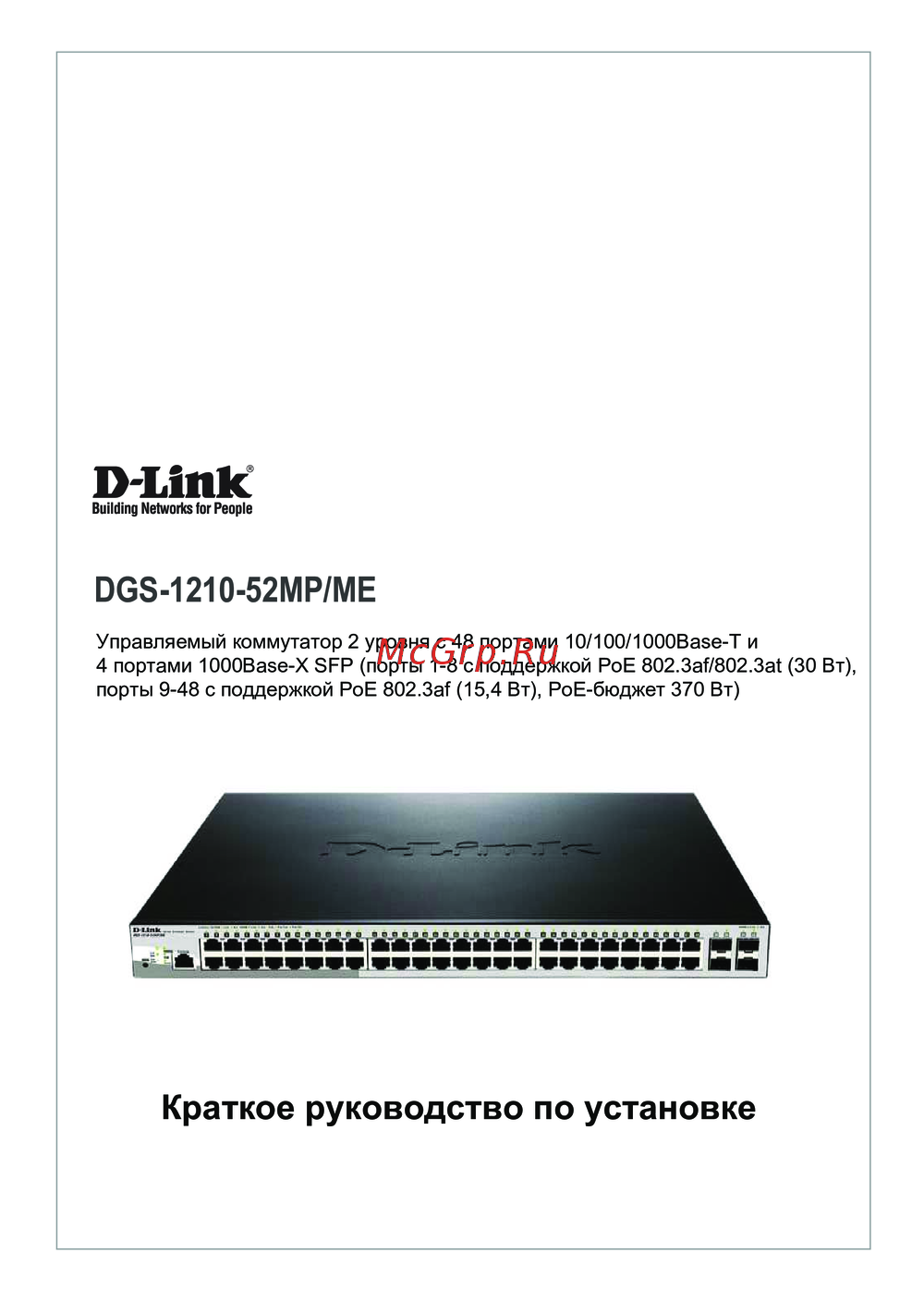 D-Link DGS-1210-52MP/MEКраткая инструкция по использованию
 -
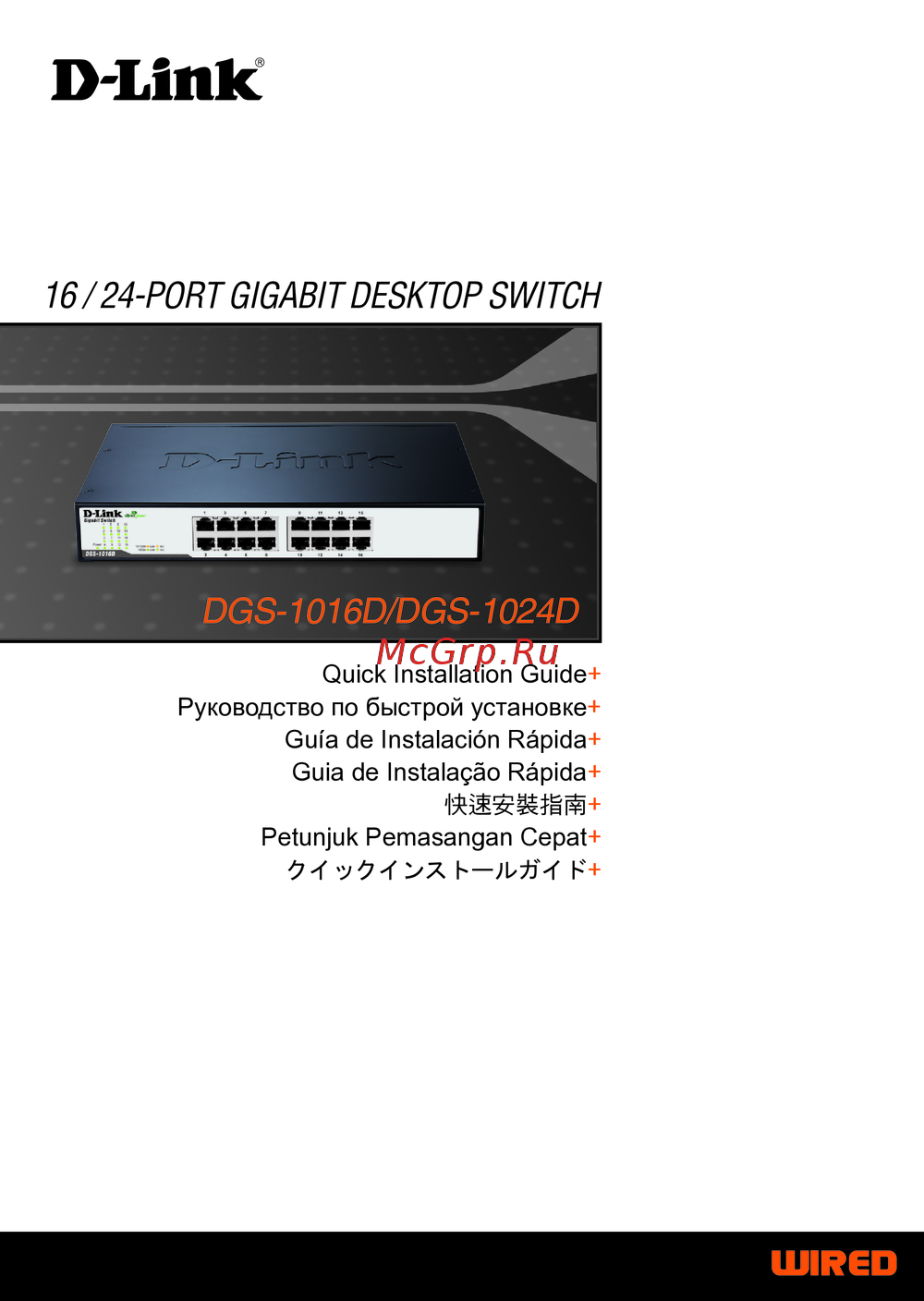 D-Link DGS-1024DИнструкция в сокращённом виде
 -
D-Link DGS-1016DРуководство по быстрому запуску
-
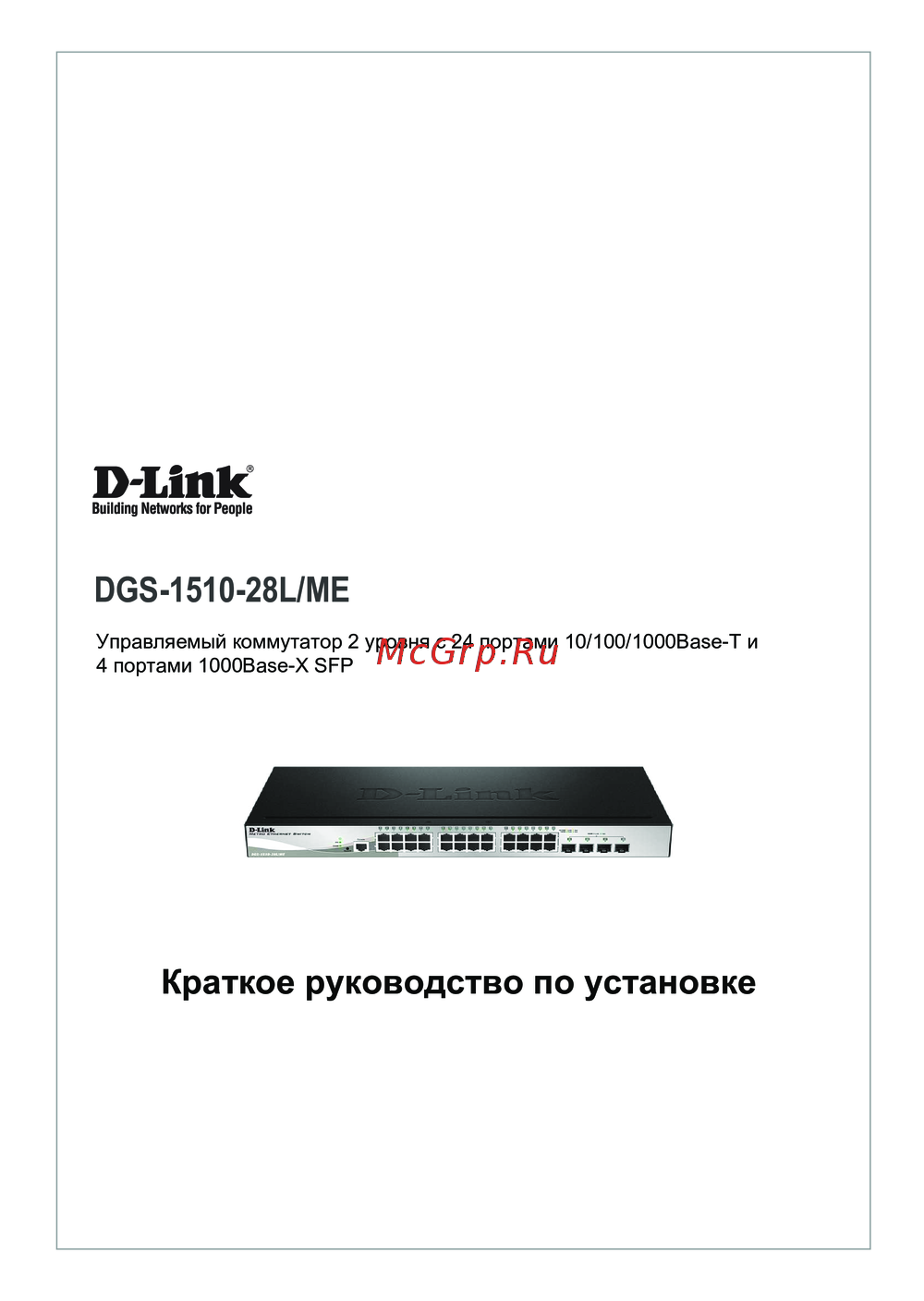 D-Link DGS-1210-28L/MEКраткий обзор функций
 -
D-Link DGS-1510-28L/MEКраткая эксплуатационная инструкция
-
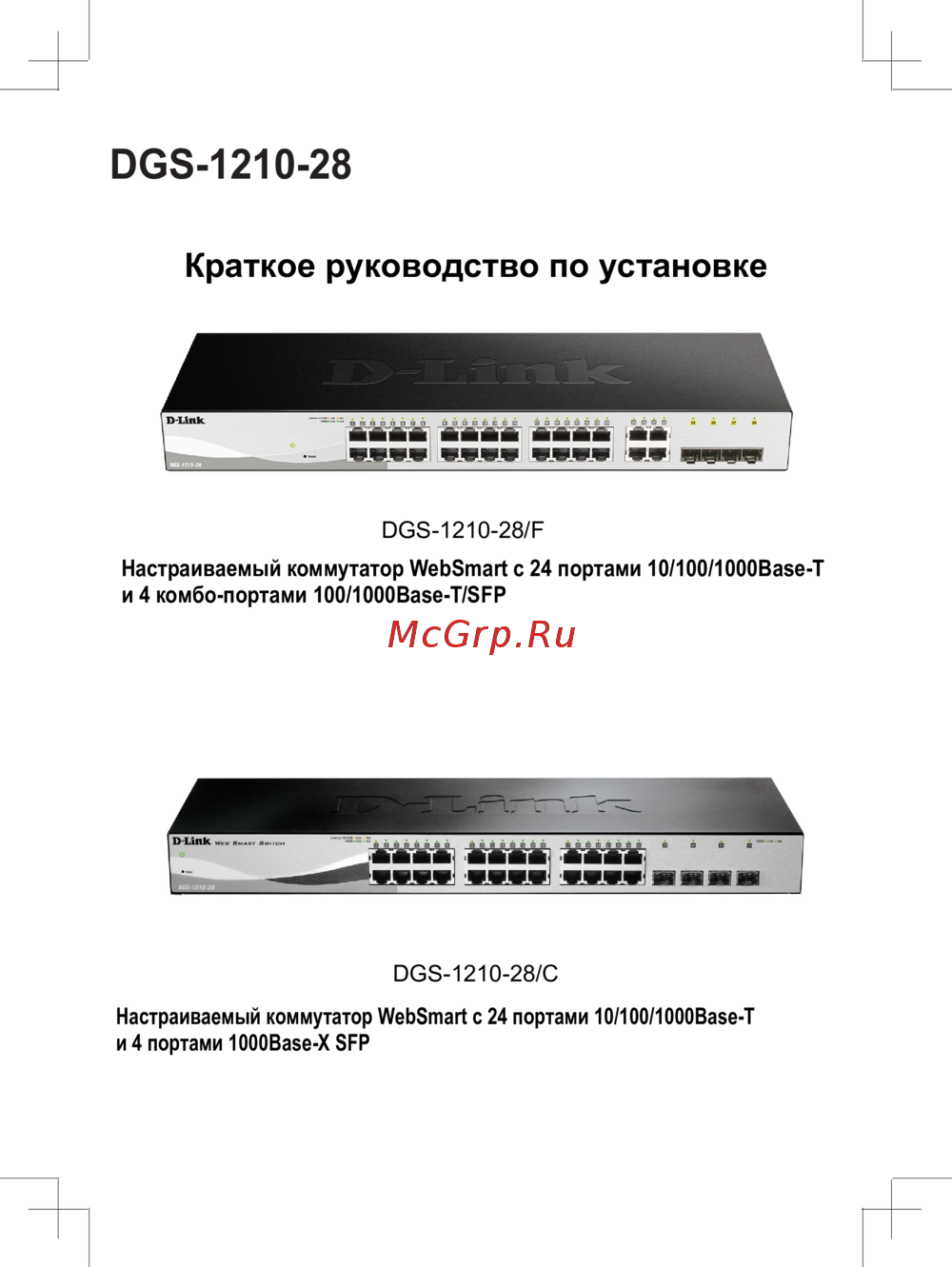 D-Link DGS-1210-28/CКраткий обзор функций
 -
D-Link DGS-1210-28/FКраткая эксплуатационная инструкция
-
D-Link DGS-1210-28Краткая инструкция по использованию
-
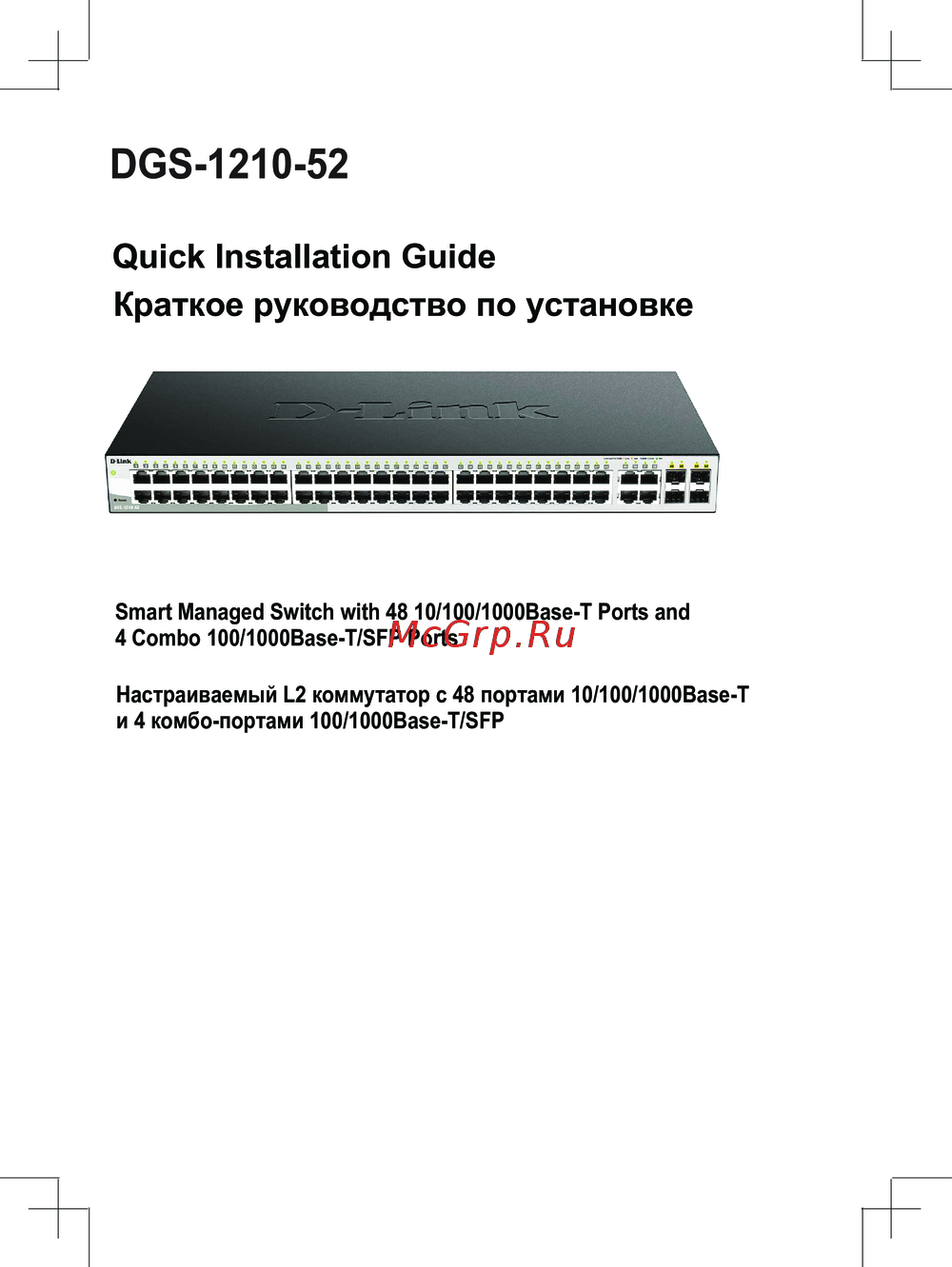 D-Link DGS-1210-52Сжатое руководство пользователя
 -
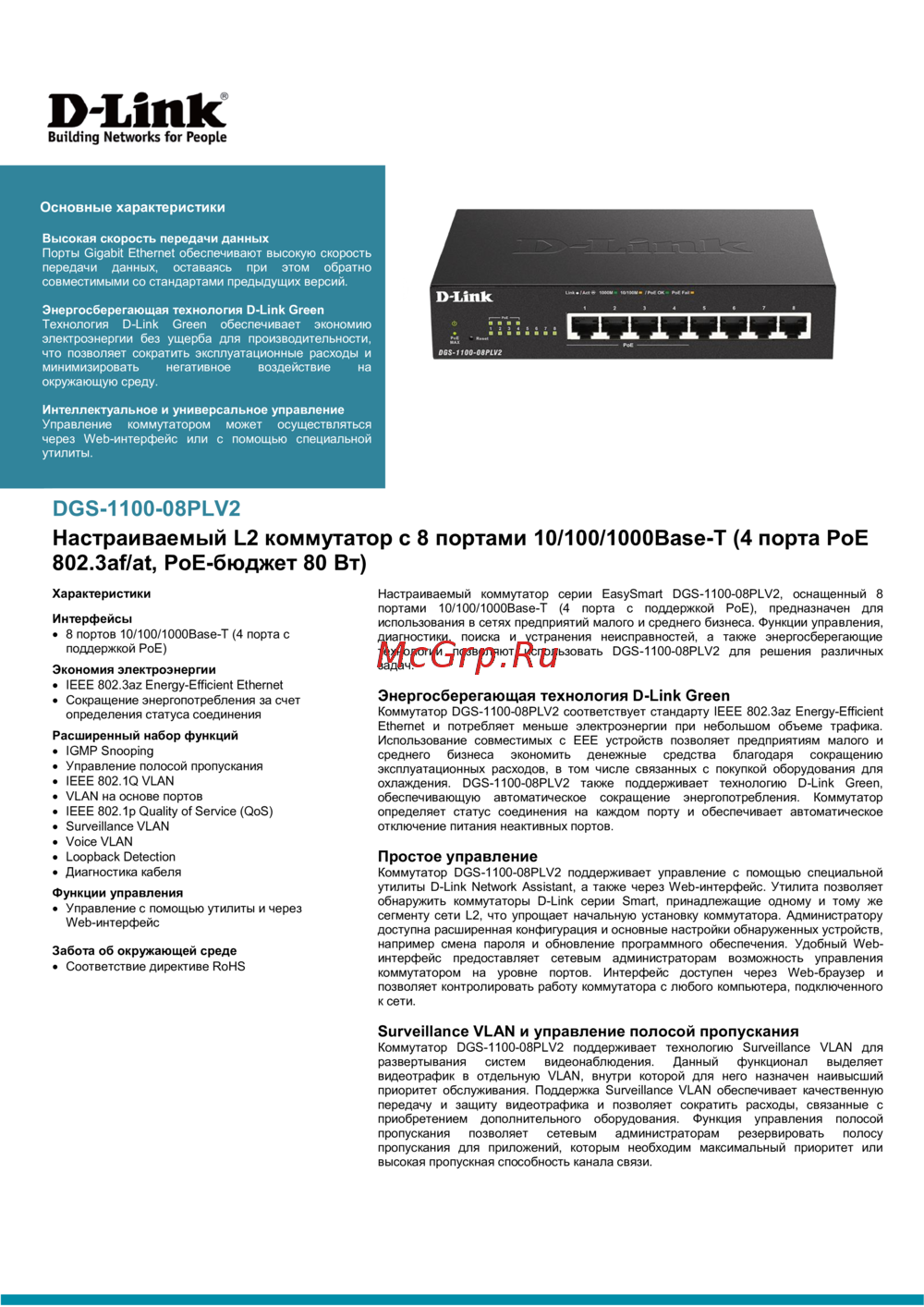 D-Link DGS-1100-08PLV2Технический паспорт устройства
Узнайте о настройках VLAN, управлении портами и их роли в сетевых коммутаторах. Обеспечьте эффективное управление трафиком и совместимость с 802.1Q.