![Stanley STSC1840-RU без акк. и з.у — инструкции по использованию зарядного устройства и инструмента [8/24]](/img/pdf.png)
Stanley STSC1840-RU без акк. и з.у — инструкции по использованию зарядного устройства и инструмента [8/24]
Превью страниц
Страница 8 /
24
![Stanley STSC1840-RU без акк. и з.у [8/24] Using sanding backing pads](/views2/1889828/page8/bg8.png)
8
ENGLISH
(Original instructions)
Leaving the battery in the charger
The charger and battery pack can be left connected with the
LED glowing indenitely. The charger will keep the battery
pack fresh and fully charged.
Charger diagnostics
If the charger detects a weak or damaged battery, the charg-
ing indicator (10) will ash red at a fast rate. Proceed as
follows:
u Re-insert the battery (7).
u If the charging indicators continues ashing red at a fast
rate, use a different battery to determine if the charging
process works properly.
u If the replaced battery charges correctly, the original
battery is defective and should be returned to a service
centre for recycling.
u If the new battery gives the same indication as the original
battery, take the charger to be tested at an authorised
services centre.
Note: It may take as long as 30 minutes to determine that
the battery is defective. If the battery is too hot or too
cold, the LED will alternately blink red, fast and slow, one
ash at each speed and repeat.
Switching on and off
u To switch on, slide the lock off switch (1) forward then
press and hold the trigger switch (2).
u To switch off, release the trigger switch (2).
Warning! Do not switch the tool on or off while under load.
Warning! Always slide the lock off switch (1) backwards to the
locked position when the tool is not in use.
Hints for optimum use
u Firmly hold the tool with one hand around the side handle
and the other hand around the main handle.
Surface grinding with grinding wheels
u Allow the tool to reach full speed before touching the tool
to the work surface.
u Apply minimum pressure to the work surface, allowing the
tool to operate at high speed. Grinding rate is greatest
when the tool operates at high speed.
u Maintain a 20˚ to 30˚ angle between the tool and work
surface.
u Continuously move the tool in a forward and back motion
to avoid creating gouges in the work surface.
u Remove the tool from work surface before turning tool off.
Allow the tool to stop rotating before laying it down.
Edge grinding with grinding wheels
Wheels used for cutting and edge grinding may break or
kick back if they bend or twist while the tool is being used
to do cut-off work or deep grinding. To reduce the risk of
serious injury, limit the use of these wheels with a standard
Type 27 guard to shallow cutting and notching (less than 1/2
inch (13mm) in depth). The open side of the guard must be
positioned away from the operator. For deeper cutting with
a Type 1 cut-off wheel, use a closed Type 1 guard. See the
Grinding and cutting chart which can be found at the back of
language section.
u Allow the tool to reach full speed before touching the tool
to the work surface.
u Apply minimum pressure to the work surface, allowing the
tool to operate at high speed. Grinding rate is greatest
when the tool operates at high speed.
u Position yourself so that the open-underside of the wheel
is facing away from you.
u Once a cut is begun and a notch is established in the
workpiece, do not change the angle of the cut. Changing
the angle will cause the wheel to bend and may cause
wheel breakage. Edge grinding wheels are not designed
to withstand side pressures caused by bending.
u Remove the tool from the work surface before turning
the tool off. Allow the tool to stop rotating before laying it
down.
Do not use edge grinding/cutting wheels for surface grinding
applications because these wheels are not designed for side
pressures encountered with surface grinding. Wheel breakage
and injury may result.
Surface nishing with sanding ap discs
u Allow the tool to reach full speed before touching the tool
to the work surface.
u Apply minimum pressure to work surface, allowing the tool
to operate at high speed. Sanding rate is greatest when
the tool operates at high speed.
u Maintain a 5˚ to 10˚ angle between the tool and work
surface.
u Continuously move the tool in a forward and back motion
to avoid creating gouges in the work surface.
u Remove the tool from work surface before turning tool off.
Allow the tool to stop rotating before laying it down.
Using sanding backing pads
Choose the proper grit sanding discs for your application.
Sanding discs are available in various grits. Coarse grits yield
faster material removal rates and a rougher nish.
Finer grits yield slower material removal and a smoother
nish.
Begin with coarse grit discs for fast, rough material removal.
Move to a medium grit paper and nish with a ne grit disc for
optimal nish.
u Coarse 16 - 30 grit
u Medium 36 - 80 grit
u Fine Finishing 100 - 120 grit
Содержание
129- Stsc1840
- Safety instructions
- Intended use
- General power tool safety warnings
- English
- English
- Additional power tool safety warnings
- English
- Additional safety warnings specific for abrasive cutting off operations
- Safety warnings specific for grinding and abrasive cutting off operations
- Kickback and related warnings
- Vibration
- Safety warnings specific for wire brushing oper tions
- Safety warnings specific for sanding operation
- Safety warnings specific for polishing operation
- Safety of others
- Residual risks
- English
- Labels on tool
- Features
- English
- Charging the battery fig a
- Additional safety instructions for batteries and chargers
- Edge grinding with grinding wheels
- Charger diagnostics
- Using sanding backing pads
- Switching on and off
- Surface grinding with grinding wheels
- Surface finishing with sanding flap discs
- Leaving the battery in the charger
- Hints for optimum use
- English
- Using wire cup brushes and wire wheels
- Using cutting wheels
- Precautions to take when sanding or wire brushing paint
- English
- Stsc1840
- From the interior when fitted
- Stanley is confident of the quality of its products and offers consumers a 24 month guarantee from the date of purchase this guarantee is in addition to and in no way prejudices your statutory rights the guarantee is valid within the territories of the member states of the european union and the european free trade area
- English
- Separate collection products and batteries marked with this symbol must not be disposed of with normal household waste
- Charger using a soft brush or dry cloth
- Remove the tool from work surface before turning tool off
- Caution applications such as cutting off or wire brushing may have different vibration emissions
- Regularly open the chuck and tap it to remove any dust
- Allow the tool to stop rotating before setting it down
- Regularly clean the ventilation slots in your appliance tool
- Regularly clean the motor housing using a damp cloth do
- Protecting the environment
- Your stanley tool has been designed to operate over a long period of time with a minimum of maintenance continuous satisfactory operation depends upon proper tool care and regular cleaning
- Products and batteries contain materials that can be recov ered or recycled reducing the demand for raw materials please recycle electrical products and batteries according to local provisions further information is available at www helpu com
- Your charger does not require any maintenance apart from regular cleaning
- Warning before performing any maintenance on corded cordless power tools
- Original instructions
- Unplug the charger before cleaning it your charger does
- Or switch off and remove the battery from the appliance
- Tool if the appliance tool has a separate battery pack
- Or run the battery down completely if it is integral and then
- To claim on the guarantee the claim must be in accordance with stanley terms and conditions and you will need to submit proof of purchase to the seller or an authorised repair agent terms and conditions of the stanley 2 year guarantee and the location of your nearest authorised repair agent can be obtained on the internet at www helpu com or by contact ing your local stanley office at the address indicated in this manual
- Not use any abrasive or solvent based cleaner
- Technical data
- Not require any maintenance apart from regular cleaning
- Switch off and unplug the appliance tool
- Maintenance
- Switch off
- Guarantee
- Українська
- Правила техники безопасности
- Общие правила безопасности при работе с электроинструментом
- Назначение
- Pусский
- Українська
- Pусский
- Українська
- Дополнительные правила безопасности при работе с электроинструментом
- Pусский
- Українська
- Специальные меры безопасности при вы полнении операций по шлифованию и резке с использованием абразивных кругов
- Отдача и предупреждения имеющие отношения к ней
- Pусский
- Українська
- Остаточные риски
- Меры предосторожности при выполнении очистки проволочной щеткой
- Меры безопасности при полировании
- Меры безопасности при выполнении зачистки
- Дополнительные меры предосторожности при абразивной резке
- Безопасность окружающих
- Pусский
- Pусский
- Условные обозначения на инструменте
- Українська
- Дополнительные меры безопасности при рабо те с аккумуляторными батареями и зарядными устройствами
- Вибрация
- Хранение аккумуляторной батареи в зарядном устройстве
- Українська
- Составные элементы комплектация
- Рис а
- Использование
- Зарядка аккумуляторной батареи рис a
- Диагностика зарядного устройства
- Pусский
- Отделка поверхности шлифовальными веерными дисками
- Использование дисков подошв для шлифования
- Включение и выключение
- Pусский
- Шлифование поверхности шлифовальными кругами
- Шлифование кромок шлифовальными кругами
- Українська
- Советы по оптимальному использованию
- Українська
- Меры предосторожности при зачистке или очистке проволочными щетками окрашенных поверхностей
- Использование чашеобразных проволочных щеток и проволочных дисков
- Pусский
- Українська
- Техническое обслуживание
- Технические характеристики
- Использование отрезных кругов
- Защита окружающей среды
- Pусский
- Внимание при выполнении таких операций как резка или очистка проволочной щеткой уровень вибрации может иметь разные значения
- Pусский
- Українська
- Перевод с оригинала инструкции
- Українська
- Приложение к руководству по эксплуатации электрооборудования для определения месяца производства по номеру текущей календарной недели года
- Перевод с оригинала инструкции
- Pусский
- Українська
- Pусский
Похожие устройства
-
 Stanley УШМ (болгарка) STGS9115-B9 +Круг отрезной DT43901-QZИнструкция
 -
Stanley УШМ (болгарка) SGS105-RU +Круг отрезной DT43902-QZИнструкция
-
 Stanley УШМ (болгарка) SGS105-RU +Круг отрезной 125х1.2х22 DT42340ZQZ 5шт.Инструкция по эксплуатации
 -
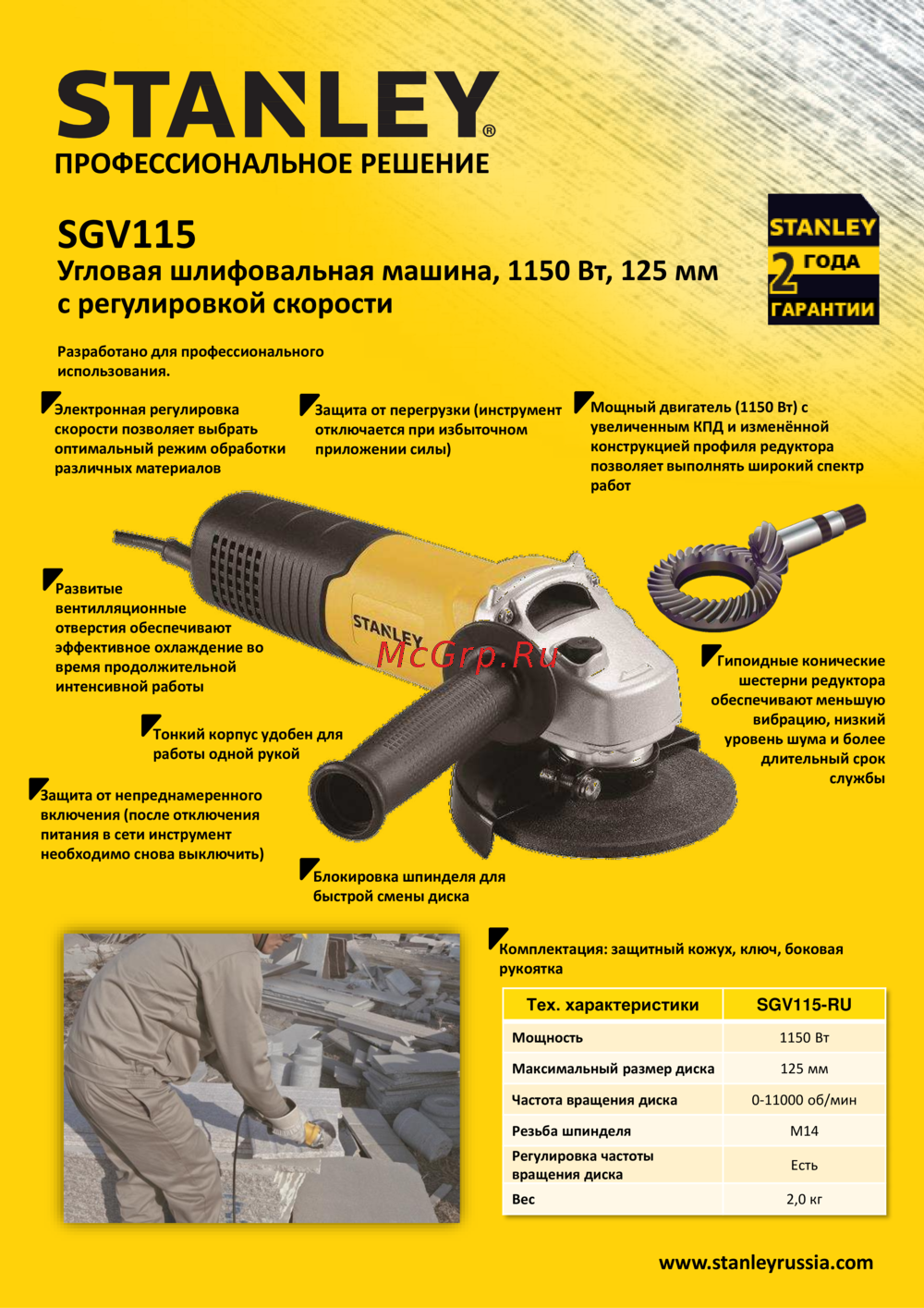 Stanley SGV115-RUИнструкция по эксплуатации
 -
 Makita GA4534Руководство по эксплуатации
 -
 AEG WS 6-125Инструкция пользователя
 -
AEG WS 6-115Руководство по настройке
-
 Makita GA4534Руководство по эксплуатации
 -
 Makita GA4534Руководство по эксплуатации
 -
 Hammer USM1200EИнструкция по эксплуатации
 -
 Denzel AG230-2400Руководство по эксплуатации
 -
 Denzel AG180-2000Руководство по эксплуатации
Узнайте, как правильно использовать зарядное устройство и инструмент для достижения максимальной эффективности. Следуйте рекомендациям по безопасности и эксплуатации.